
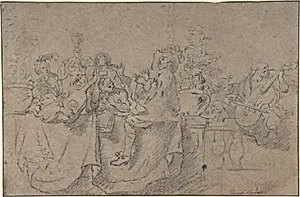
Recto: The ConcertVerso: Seated Male Nude
early 17th century
Medium
Black chalk on brown paperf
Dimensions
9 1/16 x 13 13/16 in. (23 x 35.1 cm)
Classification
Drawings
Department
Drawings and Prints
Museum
Metropolitan Museum of Art, New York, NY
Credit
Bequest of Harry G. Sperling, 1971
Accession Number
1975.131.234
Rights
Public Domain
Tags
Art Historical Context
Johann Liss, a German-born Baroque artist active in early 17th-century Venice, created this versatile drawing on brown paper using black chalk, a medium favored for its ability to evoke dramatic light and shadow with swift, expressive strokes. Measuring just 9 1/16 x 13 13/16 inches, the sheet showcases Liss's skill in rapid studies, turning a simple support into a multifaceted work: the recto *The Concert*, a lively scene of musicians with cellos and flutes, while the verso reveals a *Seated Male Nude*, highlighting the artist's focus on human anatomy. The recto's intimate gathering captures the Baroque era's fascination with music as a sensual, earthly pleasure, influenced by Venetian traditions and Caravaggesque tenebrism. Such preparatory drawings were essential for Liss's dynamic oil paintings, allowing him to explore pose, gesture, and chiaroscuro before committing to canvas. The nude verso, meanwhile, reflects the period's rigorous study of the male form from life, a cornerstone of academic training amid the Counter-Reformation's emphasis on realistic religious art. Acquired through the Bequest of Harry G. Sperling in 1971, this double-sided gem from the Metropolitan Museum of Art's Drawings and Prints collection offers a window into Liss's innovative technique and the vibrant cultural life of 17th-century Europe, where art, music, and the body intertwined.