
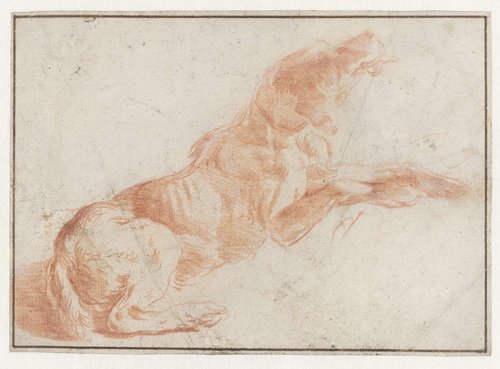
Recumbent Dog
1629 - 1668
Medium
counterproof in red chalk, reworked with red chalk; later additions in opaque white; framing line in brown ink
Dimensions
123; 174
Rights
Public Domain
About this artwork
height 123 mm x width 174 mm
Art Historical Context
Philips Wouwerman, a leading Dutch Golden Age painter active in the mid-seventeenth century, was celebrated for his lively scenes of hunts, battles, and landscapes often featuring horses and dogs. “Recumbent Dog” captures of these beloved animal subjects in a compact, intimate study. Created sometime during Wouwerman’s career (1629–1668), the drawing reflects the period’s fascination with naturalistic animal portrayal and the everyday vitality of the Dutch countryside. The work’s technique is particularly noteworthy. Executed as a counterproof in red chalk and then reworked by the artist, the sheet reveals Wouwerman’s methodical approach to composition. Counterproofing allowed him to transfer and refine forms, while later additions of opaque white heighten the sense of volume and light on the dog’s fur. A delicate brown-ink framing line further presents the sketch as a finished object worthy of collection. Though modest in scale—just 123 by 174 millimeters—this drawing offers a glimpse into Wouwerman’s creative process. Such studies helped him populate his larger paintings with convincingly observed animals, underscoring the importance of preparatory drawing in seventeenth-century Dutch studio practice.
About the Artist
Philips Wouwerman · 1619–1668
Specialized in military and hunting scenes in which horses are prominent. Son of a little known painter in Alkmaar, Paul Joosten Wouwerman. Philips died at the age of 48 reportedly as the result of an accident, having created a large number of landscapes, battle scenes and the elegant life of his time, set in castles, parties, hunting, huntsmen and prized horses.