
Recurrence
1921
Medium
lithograph with lithotint in black on wove paper
Dimensions
image (irregular): 36.2 × 44.45 cm (14 1/4 × 17 1/2 in.) sheet: 38.89 x 56.04 cm (15 5/16 x 22 1/16 in.)
Classification
Department
CG-W
Museum
National Gallery of Art, Washington, D.C.
Credit
Gift of David P. Tunick
Accession Number
2009.127.19
Rights
Public Domain
Art Historical Context
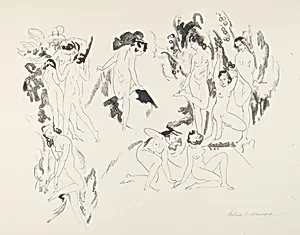
Arthur B. Davies created *Recurrence* in 1921 as a lithograph enhanced with lithotint, a technique that allows the artist to build rich tonal gradations and velvety blacks on the stone before printing. Working on wove paper, Davies produced an image measuring roughly 14 by 17 inches, its irregular edges lending an intimate, handcrafted quality to the finished sheet. The title suggests themes of repetition and rhythm, ideas that recur throughout Davies’s explorations of the human figure and landscape. As a print, *Recurrence* reflects the early-twentieth-century interest in making art more widely available. Lithography, long valued for its painterly effects, let Davies reach audiences beyond the traditional painting market while still achieving subtle atmospheric depth. The work entered the National Gallery of Art’s collection as a gift from David P. Tunick, underscoring the important role of collectors in preserving American printmaking from the modernist period. Davies, active during the rise of American modernism, often blended Symbolist mood with simplified forms. In this lithograph, the medium’s capacity for soft transitions and velvety darkness complements his interest in dreamlike, recurring motifs, inviting viewers to linger over the quiet interplay of figure and space.
About the Artist
Arthur B. Davies · 1862–1928
Arthur Bowen Davies (1862–1928) occupies one of the most paradoxical positions in American art history: a painter whose own canvases were lyrical, dreamlike, and rooted in the classical tradition, yet whose organizational energy and curatorial vision helped force American audiences into direct confrontation with the European avant-garde. Born on 26 September 1862 in Utica, New York, to English and...