
Red and white floral pattern moon flask
1880
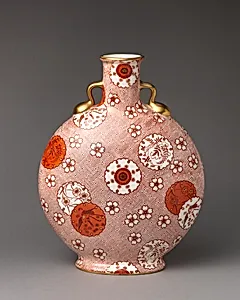
Medium
Bone china
Dimensions
confirmed: 11 3/8 × 9 1/4 × 4 3/4 in. (28.9 × 23.5 × 12.1 cm)
Classification
Ceramics-Porcelain
Culture
British, Stoke-on-Trent, Staffordshire
Department
European Sculpture and Decorative Arts
Museum
Metropolitan Museum of Art, New York, NY
Credit
Gift of Helene Fortunoff and Robert Grossman, 2017
Accession Number
2018.62.10
Rights
Public Domain
Art Historical Context
This elegant *Red and White Floral Pattern Moon Flask*, crafted by the renowned British firm Minton(s) in 1880, exemplifies the pinnacle of Victorian-era ceramics from Stoke-on-Trent, Staffordshire—the epicenter of England's pottery industry. Shaped as a moon flask, a baluster form with flattened sides and subtle handles inspired by ancient Chinese designs, it stands at 11⅜ × 9¼ × 4¾ inches, perfect for display as a luxurious decorative object in middle-class Victorian homes. Made of bone china, a translucent and durable porcelain refined in Britain during the 19th century, the flask features a striking red and white floral motif, likely achieved through meticulous transfer-printing or hand-painting techniques that showcased Minton's mastery of color and pattern. Bone china's signature ivory glow and strength made it a symbol of British innovation, rivaling finer Asian porcelains while appealing to global tastes during the height of the British Empire. Now in the Metropolitan Museum of Art's European Sculpture and Decorative Arts collection—thanks to a 2017 gift from Helene Fortunoff and Robert Grossman—this piece highlights Minton's legacy of exporting opulent wares worldwide, blending Aesthetic Movement florals with industrial precision for enduring beauty.
About the Artist
Minton(s) · 1793–2001
Minton is among the most distinguished names in the history of British ceramics, a firm whose two and a quarter centuries of production encompass everything from blue transfer-printed earthenwares to the most rarefied decorative porcelain of the Victorian age. The company was founded in 1793 by Thomas Minton (1765–1836) in Stoke-upon-Trent, Staffordshire — the heart of England's pottery industry. ...