
Red Plush Morris Chair
c. 1937
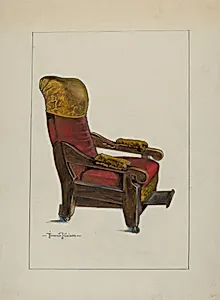
Medium
watercolor, gouache, colored pencil, and graphite on paper
Dimensions
overall: 31.4 x 23.3 cm (12 3/8 x 9 3/16 in.) Original IAD Object: 44"high. 28" arm length; 25 1/2"wide at arms. Extends to 66 1/4".
Classification
Index of American Design
Department
CG-W
Museum
National Gallery of Art, Washington, D.C.
Credit
Index of American Design
Accession Number
1943.8.4452
Rights
Public Domain
Art Historical Context
In the heart of the Great Depression, artist Florence Truelson contributed to the Index of American Design (IAD), a Federal Art Project under the Works Progress Administration (WPA). Her captivating rendering, *Red Plush Morris Chair* (c. 1937), meticulously documents a quintessential piece of American furniture. Part of the National Gallery of Art's collection, this work preserves the chair's elegant form—a 44-inch-high recliner with 28-inch arms, 25½-inch width, and an adjustable back extending to 66¼ inches—for future generations. Truelson employed a rich mix of watercolor, gouache, colored pencil, and graphite on paper (31.4 x 23.3 cm), achieving luminous reds in the plush upholstery against the chair's sturdy wooden frame. This multi-layered technique captures texture and depth, highlighting the Morris chair's Arts and Crafts roots, originally designed by William Morris in the late 19th century. Popularized in America, plush-upholstered versions like this one symbolized cozy domestic comfort amid economic hardship. As an IAD highlight, the piece underscores America's design heritage, blending functionality with aesthetic appeal. Visitors, imagine sinking into its embrace—Truelson's art revives that timeless allure!
About the Artist
Florence Truelson · 1901–1959
Florence Truelson is an artist whose biographical details remain largely undocumented in the major art historical sources. No confirmed dates of birth or death have been established, and her nationality, training, and primary working period are not reliably recorded in available scholarship. Works attributed to Truelson suggest a practiced hand and an awareness of the artistic conventions of her ...