
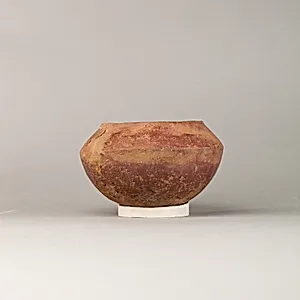
Red polished ware bowl
Unknown Artist
ca. 3850–2960 B.C.
Medium
Pottery
Classification
Bowl
Period
Predynastic Period
Department
Egyptian Art
Museum
Metropolitan Museum of Art, New York, NY
Credit
Rogers Fund, 1936
Accession Number
36.1.154
Rights
Public Domain
Art Historical Context
This exquisite red polished ware bowl hails from Egypt's Predynastic Periodca. 3850–2960 B.C.), a formative era before the unification of Upper and Lower Egypt around 3100 B.C. Crafted by an unknown artisan, it exemplifies the Naqada I culture's early mastery of pottery, one of the oldest surviving art forms from ancient Egypt. Such vessels were likely used in daily life, rituals, or elite burials, offering a glimpse into a society transitioning from nomadic hunter-gatherers to agricultural communities along the Nile. The bowl's defining feature is its vibrant red slip, meticulously polished to a glossy sheen through burnishing with stones—a labor-intensive technique that enhanced both durability and aesthetic appeal. This red polished ware, often with a contrasting black rim from oxidized firing, highlights innovative control over clay, pigments, and kilns. Artistically, it foreshadows the refined ceramics of the Dynastic periods, symbolizing emerging social hierarchies and trade networks. Acquired through the Rogers Fund in 1936, this bowl at the Metropolitan Museum of Art invites visitors to ponder the ingenuity of Predynastic Egyptians, whose simple yet sophisticated pottery laid the foundation for millennia of artistic excellence.