
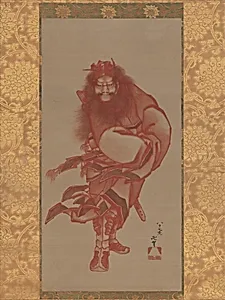
Red Zhong Kui, the Demon Queller
Medium
Hanging scroll; ink and color on silk
Dimensions
Image: 23 1/4 × 11 7/8 in. (59.1 × 30.2 cm) Overall with mounting: 61 × 19 1/2 in. (154.9 × 49.6 cm) Overall with knobs: 61 × 21 5/16 in. (154.9 × 54.1 cm)
Classification
Paintings
Culture & Period
Japan · Edo period (1615–1868)
Department
Asian Art
Museum
Metropolitan Museum of Art, New York, NY
Credit
Charles Stewart Smith Collection, Gift of Mrs. Charles Stewart Smith, Charles Stewart Smith Jr., and Howard Caswell Smith, in memory of Charles Stewart Smith, 1914
Accession Number
14.76.37
Rights
Public Domain
Tags
Art Historical Context
Katsushika Hokus, the legendary Japanese artist renowned for his ukiyo-e woodblock prints like *The Great Wave off Kanagawa*, created *Red Zhong Kui, the Queller* in 1846, near the end of his prolific career. This hanging scroll, painted in vibrant ink and color on silk measures about 23 by 12 inches and depicts the fierce Chinese folk hero Zhong Kui—a mythical warrior tasked with vanquishing demons and protecting against evil spirits. Hokus's bold portrayal, with Zhong Kui rendered in striking red hues, captures the figure's dynamic energy and protective power, a motif adapted into Japanese art during the Edo period (1615–1868). Hanging scrolls like this were prized treasures in Edo-era Japan, unrolled for special occasions to adorn homes or temples, emphasizing their role in both decoration and spiritual ritual. Zhong Kui's legend, originating in Chinese Taoism, resonated in Japan as a guardian against misfortune, especially around the New Year. Hokusai's mastery shines in his fluid ink lines and vivid pigmentation on silk, which allowed for luminous colors and subtle textures, blending traditional Chinese subject matter with his signature Japanese dynamism. Now housed in the Metropolitan Museum of Art's Asian Art collection, this work exemplifies Hokusai's versatility beyond prints, bridging cultures and showcasing Edo Japan's artistic golden age. Visitors will appreciate its vivid storytelling and timeless appeal as a talisman against the unseen.
About the Artist
Katsushika Hokusai 葛飾北斎 (Japanese) · 1760 –1849
Japanese, Tokyo (Edo) 1760–1849 Tokyo (Edo)