
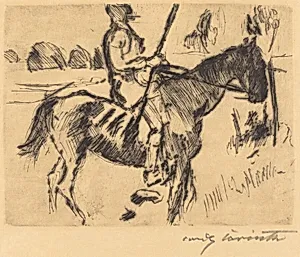
Reiter (Rider)
1925
Medium
drypoint in black
Dimensions
plate: 11 × 14.2 cm (4 5/16 × 5 9/16 in.)
Classification
Department
CG-W
Museum
National Gallery of Art, Washington, D.C.
Credit
Rosenwald Collection
Accession Number
1951.10.19
Rights
Public Domain
Art Historical Context
**Reiter (Rider)**, a striking drypoint print created by Lovis Corinth in 1925, captures the German master's late-career intensity just months before his death. Corinth (1858–1925), a pivotal figure in Germanism, evolved from Impressionist influences to a bolder, more emotive style after a debilitating stroke in 1911. This small-scale work (plate: 11 × 14.2 cm) reflects his final years amid the cultural ferment of Weimar Germany, where artists grappled with modernity and personal frailty. Drypoint, Corinth's chosen medium here, involves scratching directly into a copper plate with a steel needle, raising a soft burr that yields rich, velvety black lines upon inking and printing. Unlike smoother etching techniques, drypoint's tactile immediacy suited Corinth's vigorous hand, producing editions with subtle tonal variations. The title *Reiter* evokes dynamic motion, aligning with his fascination with equestrian themes and the raw energy of Expressionist form. Housed in the National Gallery of Art's Rosenwald Collection—a treasure trove of master prints—this piece exemplifies Corinth's graphic prowess. For visitors, it offers a window into an artist's defiant creativity at life's edge, blending technical innovation with profound emotional depth.
About the Artist
Lovis Corinth · 1858–1925
Lovis Corinth, born Franz Heinrich Louis on July 21, 1858, in Tapiau, East Prussia (now Gvardeysk, Russia), to a tanner father, displayed prodigious drawing talent from childhood. He began formal training at the Königsberg Academy in 1876, then moved to the Academy of Fine Arts in Munich from 1880 to 1884, studying under Ludwig von Löfftz and briefly Franz von Defregger, where he absorbed a Realis...