
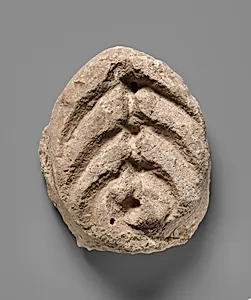
Relief fragment
Unknown Artist
ca. 6th–8th century CE
Medium
Stucco
Dimensions
4 5/8 × 3 7/8 × 1 13/16 in. (11.8 × 9.8 × 4.6 cm)
Classification
Stucco-Reliefs
Culture & Period
Sasanian or Islamic · Sasanian–early Islamic
Department
Ancient Near Eastern Art
Museum
Metropolitan Museum of Art, New York, NY
Credit
Rogers Fund, 1932
Accession Number
32.150.57
Rights
Public Domain
Art Historical Context
This delicate stucco relief fragment, dating to around the 6th–8th century CE, offers a glimpse into the artistic world of the Sasanian or early Islamic periods in the Ancient Near East. Measuring just under 5 inches wide, it likely originated as part of a larger architectural decoration, such as wall panels or archways in palaces, temples, or elite residences. Acquired through the Rogers Fund in 1932, it now resides in the Metropolitan Museum of Art's Department of Ancient Near Eastern Art, exemplifying the region's sophisticated craftsmanship during a pivotal era. Stucco, a versatile plaster-like medium molded or carved while wet, was prized in Sasanian art for its ability to mimic stone reliefs at lower cost, allowing intricate designs on expansive surfaces. This fragment bridges the late Sasanian Empire (224–651 CE), known for its imperial grandeur and Zoroastrian motifs, and the dawn of Islamic rule, when artistic traditions evolved yet retained Persian influences. Such pieces highlight cultural continuity amid conquest, blending figural or ornamental elements that adorned spaces of power and worship. Though worn by time, this modest survivor underscores the Near East's enduring legacy of architectural artistry, inviting us to imagine the vibrant halls it once embellished.