
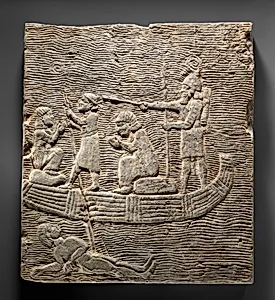
Relief fragment: Assyrian soldier conducting captives across the water
Unknown Artist
ca. 668–627 BCE
Medium
Gypsum alabaster
Dimensions
20 1/4 × 17 13/16 × 1 7/8 in., 48 lb. (51.5 × 45.3 × 4.8 cm)
Classification
Stone-Reliefs
Culture & Period
Assyrian · Neo-Assyrian
Department
Ancient Near Eastern Art
Museum
Metropolitan Museum of Art, New York, NY
Credit
Gift of John D. Rockefeller Jr., 1932
Accession Number
32.143.5
Rights
Public Domain
Tags
Art Historical Context
In this gypsum alabaster relief, a boat glides across water rendered as flowing, incised lines. Four figures fill the vessel: one stands at the prow, arm extended in a commanding gesture, while the others sit kneel, some grasping poles. A fifth figure appears partially submerged below, reaching upward. The shallow carving captures details of helmets, short tunics, and beards with crisp outlines against the textured background of horizontal waves and a narrow upper register. Created by an unknown Assyrian artist around 668–627 BCE during the Neo-Assyrian period, this fragment once formed part of a larger palace wall relief. Such works documented military campaigns and the transport of captives, underscoring the power and reach of the Assyrian kings. The scene reflects the empire’s emphasis on recording real events in durable stone to convey authority and order. Now in the Metropolitan Museum of Art’s collection as a gift of John D. Rockefeller Jr., the piece invites viewers to consider how ancient sculptors transformed limestone into vivid historical narrative.