
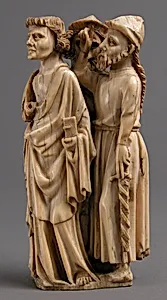
Relief from a Crucifixion Group
Unknown Artist
14th century (?)
Medium
Ivory
Dimensions
Overall: 4 13/16 x 2 1/4 x 1 in. (12.2 x 5.7 x 2.5 cm)
Classification
Ivories
Culture
North French, British or Netherlandish (?)
Department
Medieval Art
Museum
Metropolitan Museum of Art, New York, NY
Credit
Gift of J. Pierpont Morgan, 1917
Accession Number
17.190.206
Rights
Public Domain
Art Historical Context
This delicate ivory relief, likely from a larger Crucifixion Group sculpted in the 14th, captures a poignant moment from Christ's Passion, possibly featuring mourners at the foot of the cross. Carved in northern France, Britain, or the Netherlands, its small scale—barely five inches tall—suggests it was designed for intimate, personal devotion, perhaps as part of a portable diptych or devotional box carried by pilgrims or nobles. Ivory, a luxurious medium sourced from elephant tusks via medieval trade routes, allowed artists to achieve extraordinary finesse in relief carving. The unknown sculptor's technique reveals intricate undercutting and subtle modeling, hallmarks of Gothic artistry, where light and shadow brought biblical scenes to vivid life. Such works underscored the era's intense religious fervor, blending emotional expressiveness with technical virtuosity amid the Black Death's shadow. Today, this treasure at the Metropolitan Museum of Art, gifted by J. Pierpont Morgan in 1917, invites us to ponder medieval faith's tactile intimacy—hold it in your mind's eye, and feel the weight of history in your hands.