
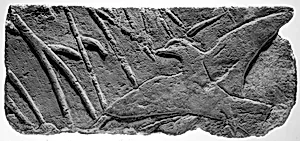
Relief with a bird
Unknown Artist
ca. 1353–1336 B.C.
Medium
Limestone, paint (mostly modern)
Dimensions
9 x 20 1/2 in. (22.8 x 52 cm)
Classification
Talatat, bird
Period
New Kingdom, Amarna Period
Department
Egyptian Art
Museum
Metropolitan Museum of Art, New York, NY
Credit
Purchase, The Joseph Rosen Foundation Inc. Gift, Ludlow Bull and Rogers Funds, and Lila Acheson Wallace, Schimmel Foundation Inc.,and Nathaniel Spear Jr. Gifts, 1992
Accession Number
1992.86
Rights
Public Domain
Tags
Art Historical Context
This delicate limestone relief, titled *Relief with a Bird dates to the Amarna Period of Egypt's New Kingdom (ca 1353–1336 B.C.), during Dynasty 18. Carved from a modest slab measuring just 9 x 20½ inches, it exemplifies the revolutionary art produced under Pharaoh Akhenaten's rule at his new capital, Amarna. Unlike the stiff, idealized figures of earlier Egyptian art, Amarna reliefs embraced a more naturalistic style, capturing the fluidity of life and nature with elongated forms and intimate details. The central bird, rendered in shallow relief, likely evokes the vibrant wildlife of the Nile Valley, a motif symbolizing renewal, the soul (as the *ba* bird), or the life-giving forces celebrated in Akhenaten's Aten sun-god worship. Traces of paint—mostly modern restorations—hint at the original vivid colors that once animated these scenes, a technique used to bring tomb or temple walls to vivid life. Such small-scale reliefs were often fragments from larger decorative programs, offering glimpses into elite daily life or religious devotion. Housed in the Metropolitan Museum of Art's Egyptian Art department, this piece invites visitors to ponder the Amarna artistic revolution—a bold shift toward realism that briefly transformed Egyptian aesthetics before traditional styles returned. Its simplicity belies profound cultural insights into a pivotal era of innovation and monotheistic fervor.