
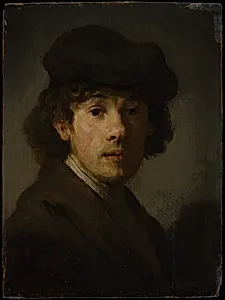
Rembrandt (1606–1669) as a Young Man
Medium
Oil on wood
Dimensions
8 5/8 x 6 1/2 in. (21.9 x 16.5 cm)
Classification
Paintings
Department
European Paintings
Museum
Metropolitan Museum of Art, New York, NY
Credit
Bequest of Evander B. Schley, 1952
Accession Number
53.18
Rights
Public Domain
Tags
Art Historical Context
Behold the youthful gaze of Rembrandt Harmenszoon van Rijn in his self-portrait *Rembrandt (16061669) as a Young Man*, a gem from the Dutch master's early career. Captured in oil on wood—a favored medium for intimate 17th-century panels—this diminutive work (just 8⅝ × 6½ inches) invites visitors to lean in close, as if peering into the artist's own studio mirror. Rembrandt, one of the greatest portraitists of the Baroque era, produced over 80 self-portraits across his life, using them to experiment with expression, costume, and character. The small scale and wooden support suggest this was likely a personal study or tronie—a Dutch term for expressive head studies—common among artists honing their craft during the Dutch Golden Age. Rembrandt's genius shines in his masterful use of chiaroscuro, the dramatic play of light and shadow that sculpts the face with psychological depth, foreshadowing his later masterpieces like *The Night Watch*. Though the exact date remains unknown, it captures the ambition of a rising talent in Leiden or Amsterdam around the 1620s–30s. Housed in the Metropolitan Museum of Art's European Paintings department through the 1952 bequest of Evander B. Schley, this portrait reminds us of Rembrandt's enduring fascination with self-examination. It's a window into the man behind the myth, blending technical virtuosity with raw humanity—perfect for contemplating the artistry of introspection.