
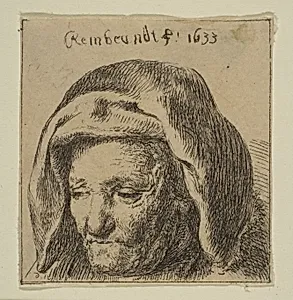
Rembrandt's Mother in a Cloth Headress, Looking Down
Medium
Etching
Dimensions
Sheet: 1 11/16 × 1 5/8 in. (4.3 × 4.1 cm)
Classification
Prints
Department
Drawings and Prints
Museum
Metropolitan Museum of Art, New York, NY
Credit
Bequest of Harry G. Friedman, 1965
Accession Number
66.521.16
Rights
Public Domain
Tags
Art Historical Context
In the intimate etching *Rembrandt's Mother in Cloth Headdress, Looking Down*, Rembrandt van Rijn captures a portrait of his mother,eltgen Willemsdochter van Zuytbrouck, gazing downward with quiet introspection. Created in the 17th century during Rembrandt's early career in Amsterdam, this small-scale work (just 1 11/16 × 1 5/8 inches) exemplifies the Dutch master's innovative approach to printmaking. Associated with the Baroque period, Rembrandt's etchings often blended profound psychological depth with everyday subjects, elevating familial figures to icons of human emotion. Etching, Rembrandt's preferred medium here, allowed for delicate lines and rich tonal variations achieved through biting acid into a copper plate. This technique revolutionized printmaking, enabling subtle textures like the soft folds of the cloth headdress and the gentle modeling of her face. Produced around the late 1620s, it reflects the young artist's experimentation with light and shadow, hallmarks of his genius that would influence generations. Housed in the Metropolitan Museum of Art's Drawings and Prints department through the 1965 bequest of Harry G. Friedman, this print offers visitors a glimpse into Rembrandt's personal life and his mastery of the intimate portrait. Its focus on a woman's contemplative expression underscores themes of aging and devotion, resonating across centuries.
About the Artist
baron Dominique Vivant Denon|Rembrandt (Rembrandt van Rijn) · 1747–1825
Dominique Vivant, Baron Denon (1747–1825), was a multifaceted French artist, diplomat, and archaeologist whose life bridged the Ancien Régime, Revolution, and Napoleonic Empire. Born on January 4, 1747, in Givry near Chalon-sur-Saône to a family of minor nobility originally surnamed "de Non," he was sent to Paris at eighteen to study law. Instead, he pursued art, studying painting under Noël Hallé...