
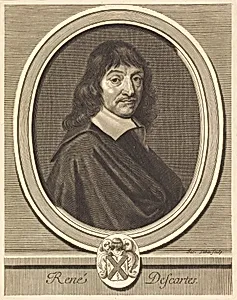
René Descartes
1651 to 1700
Medium
engraving on laid paper
Dimensions
plate: 25.1 x 19.6 cm (9 7/8 x 7 11/16 in.) sheet: 26.2 x 20.9 cm (10 5/16 x 8 1/4 in.)
Classification
Department
CG-E
Museum
National Gallery of Art, Washington, D.C.
Credit
Gift of John O'Brien
Accession Number
1987.70.1
Rights
Public Domain
Art Historical Context
This elegant engraving, titled *René Descartes*, captures likeness of the renowned French philosopher (1596–1650), often called the father of modern philosophy for his foundational ideas like "Cogito, ergo sum" ("I think, I am"). Created by Jacques Lubin, a skilled French engraver active in late 17th century the print dates to between 1651 and 1700—likely a posthumous tribute produced soon after Descartes' death in Sweden. Measuring a modest plate size of .1 x 19.6 cm on laid paper, it exemplifies the intimate scale of period portrait prints. Engraving on laid paper was a hallmark technique of the Baroque era, where Lubin incised fine lines into a metal plate, inked it, and pressed it onto the textured, chain-lined paper to produce crisp, detailed reproductions. This method allowed for widespread dissemination of intellectual portraits, making Descartes' stern, contemplative visage accessible to scholars and admirers across Europe. Housed in the National Gallery of Art's print collection (gift of John O'Brien), this work highlights the cultural reverence for Descartes during the Enlightenment's dawn. Such engravings bridged art and ideas, immortalizing thinkers whose legacies shaped science and rationalism, inviting visitors to ponder the mind behind modernity.