
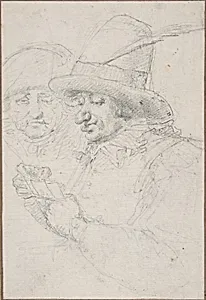
Replacements in the Parisian Guard Playing Cards
ca. 1795
Medium
Black chalk
Dimensions
6 9/16 x 4 7/16 in. (16.6 x 11.3 cm)
Classification
Drawings
Department
Drawings and Prints
Museum
Metropolitan Museum of Art, New York, NY
Credit
Rogers Fund, 1962
Accession Number
62.119.7c
Rights
Public Domain
Tags
Art Historical Context
In the turbulent aftermath of the French Revolution, Dominique Vivant Denon captured a slice of everyday camaraderie in *Replacements in the Parisian Guard Playing Cards (ca. 1795). This intimate black chalk drawing, measuring just 6 9/16 x 4 7/16 inches, depicts men—likely new recruits or "replacements" in the National Guard—engaged in a lively game of cards. Denon, a versatile artist, diplomat, and future director of the Louvre under Napoleon, excelled in such genre scenes, blending neoclassical precision with observational realism. Created during the Directory period, when revolutionary fervor was giving way to political instability, the work offers a poignant glimpse into the lives of ordinary soldiers. The Parisian Guard, once defenders of the Republic, symbolized the era's shifting loyalties and conscription demands. Amid battles and purges, moments like this card game highlight human resilience and leisure as brief escapes from chaos. Denon's masterful use of black chalk allows for subtle tonal modeling and expressive lines, ideal for quick, on-the-spot sketches that convey texture and gesture on a small scale. Housed in the Metropolitan Museum of Art's Drawings and Prints department (Rogers Fund, 1962), this piece invites visitors to appreciate how art preserves the unheroic, relatable side of history.
About the Artist
baron Dominique Vivant Denon · 1747–1825
Dominique Vivant, Baron Denon (1747–1825), was a multifaceted French artist, diplomat, and archaeologist whose life bridged the Ancien Régime, Revolution, and Napoleonic Empire. Born on January 4, 1747, in Givry near Chalon-sur-Saône to a family of minor nobility originally surnamed "de Non," he was sent to Paris at eighteen to study law. Instead, he pursued art, studying painting under Noël Hallé...