
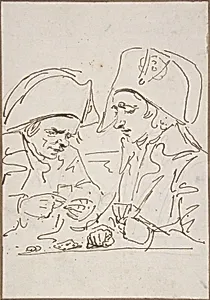
Replacements in the Parisian Guard Playing Cards in 1795
ca. 1795
Medium
Pen and brown ink over traces of black chalk
Dimensions
6 9/16 x 4 9/16 in. (16.6 x 11.6 cm)
Classification
Drawings
Department
Drawings and Prints
Museum
Metropolitan Museum of Art, New York, NY
Credit
Rogers Fund, 1962
Accession Number
62.119.7b
Rights
Public Domain
Tags
Art Historical Context
In the turbulent final days of the French Revolution Baron Dominique Vivant Denon a slice of everyday life in his drawing *Replacements in the Parisian Playing Cards in 179*. Created around 1795, this modest sheet—measuring just 6 9/16 x 4 9/16 inches (16.6 x 11.6 cm)—employs pen and brown ink faint traces of black chalk, technique that lends fluid, expressive lines and subtle tonal depth. Denon, a versatile artist, diplomat, and future director of the Louvre under Napoleon, excelled in quick, observational sketches that blended neoclassical precision with genre-scene vitality. The title evokes the chaotic manpower shifts in Paris's National Guard during the Directory period (1795–1799), when "replacements" filled ranks depleted by war and revolution. Here, uniformed men huddle over playing cards, their relaxed postures contrasting the era's political upheaval—a poignant reminder of soldiers seeking normalcy amid guillotines and riots. Such scenes highlight Denon's eye for human detail, turning a fleeting moment into cultural testimony. This Rogers Fund acquisition at The Metropolitan Museum of Art showcases ink's intimacy for portable studies, inviting us to ponder how games bridged fear and fellowship in revolutionary France. A gem for history buffs!
About the Artist
baron Dominique Vivant Denon · 1747–1825
Dominique Vivant, Baron Denon (1747–1825), was a multifaceted French artist, diplomat, and archaeologist whose life bridged the Ancien Régime, Revolution, and Napoleonic Empire. Born on January 4, 1747, in Givry near Chalon-sur-Saône to a family of minor nobility originally surnamed "de Non," he was sent to Paris at eighteen to study law. Instead, he pursued art, studying painting under Noël Hallé...