
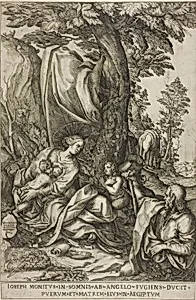
Rest on the Flight into Egypt
Medium
Etching and engraving in black on ivory laid paper
Dimensions
43 × 28.1 cm (16 15/16 × 11 1/8 in.)
Classification
engraving
Department
Prints and Drawings
Museum
Art Institute of Chicago
Accession Number
80176
Rights
Public Domain
About this artwork
Bernardino Passeri was a painter, engraver, and printer who worked in Rome in the last decades of the 16th century. This monumental engraving probably belonged to a larger series of related religious subjects of the same year. In this composition, the exaggerated movement of the trees and landscape is complicated by Joseph’s placement, leaning out into the viewer’s space—a typical Baroque device. Although many of Passeri’s designs were reproduced by other engravers, the inscription on this examp...
Art Historical Context
Bernardino Passeri's *Rest on the Flight into Egypt* (1583) captures a tender moment from the biblical narrative in which the Holy Family pauses during their escape from King Herod's massacre of the innocents. This late Renaissance engraving depicts the Virgin Mary, infant Jesus, and Saint Joseph in a serene landscape, a popular motif in Christian art that emphasized maternal devotion and divine protection. Passeri, an Italian printmaker active in Rome, skillfully rendered this scene with intricate line work, drawing from the era's heightened interest in religious iconography amid the Catholic Counter-Reformation. Executed as an etching and engraving in black ink on ivory laid paper—a fine, textured support typical of 16th-century European printmaking—this work measures an impressive 43 × 28.1 cm, making it suitable for both private devotion and display. Engraving's precision allowed Passeri to achieve rich tonal contrasts and fine details, techniques that made prints affordable reproductions of paintings, democratizing access to sacred art for a broader audience beyond elite collectors. Housed in the Art Institute of Chicago's Prints and Drawings Department, this piece exemplifies the technical mastery of Mannerist-era printmaking, blending narrative storytelling with virtuoso craftsmanship. Visitors will appreciate its historical role in spreading Counter-Reformation imagery, inviting quiet reflection on faith and humanity's journey.