
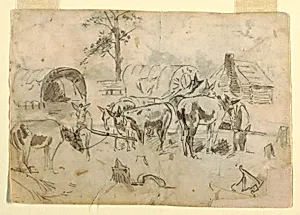
Resting Mules Tethered to Wagons
Medium
animals
Classification
animals
Department
Smithsonian Collection
Museum
Smithsonian American Art Museum
Credit
Gift of Charles Savage Homer, Jr.
Accession Number
1912-12-172
Rights
Public Domain
About this artwork
Recto: Horizontal view of a resting wagon train, with tethered mules; tree and log cabin visible in background.
Art Historical Context
Winslow Homer's *Resting Mules Tethered to Wagons* (1862) captures a quiet moment amid the rigors of 19th-century American travel. This horizontal sketch depicts a weary wagon train at rest, with mules tethered patiently to their loads. In the background, a solitary tree and rustic log cabin evoke the vast, untamed landscapes of the American frontier, rendered with Homer's keen eye for everyday realism. Created during the Civil War, when Homer served as an artist-correspondent for *Harper's Weekly*, the work likely draws from scenes of military supply lines or westward migration. Mules, vital beasts of burden for armies and pioneers alike, symbolize resilience and the gritty backbone of expansion. Homer's realistic style—part of the American Realism movement—shuns romanticism for truthful observation, using precise lines to convey texture and depth on what appears to be a recto sketch sheet. Housed in the Smithsonian American Art Museum through a family gift, this piece highlights Homer's early mastery of capturing transient life. It invites visitors to ponder the human (and animal) endurance that shaped a nation, blending historical grit with artistic simplicity.