
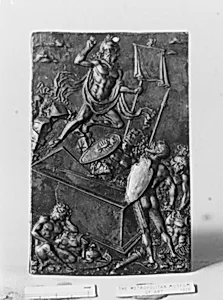
Resurrection of Christ
late 15th–early 16th century
Medium
Bronze
Dimensions
4 × 2 1/2 in. (10.2 × 6.4 cm)
Classification
Medals and Plaquettes
Culture
Italian
Department
European Sculpture and Decorative Arts
Museum
Metropolitan Museum of Art, New York, NY
Credit
Gift of Ogden Mills, 1925
Accession Number
25.142.30
Rights
Public Domain
Tags
Art Historical Context
Behold the *Resurrection of Christ*, delicate bronze plaquette crafted by Galeazzo Mondella known as Moderno, late 15th–early 16th-century Italy. Measuring just 4 × 2½ inches, this intimate relief captures the triumphant moment of Christ's rising from the tomb, surrounded by adoring angels—a quintessential Renaissance depiction of faith and renewal. Moderno, a master medallist from the Veneto region, drew inspiration from classical antiquity, blending antique motifs with Christian iconography in his finely detailed works. During the Renaissance, small-scale bronzes like this one flourished as collectible art objects, prized by scholars, nobles, and clergy for both devotional use and scholarly contemplation. Cast in bronze, the medium allowed for exquisite low-relief carving, showcasing Moderno's skill in capturing dynamic movement and expressive faces within a compact form. Plaquette such as this bridged sculpture and printmaking, making grand biblical narratives accessible for personal meditation. Today, this piece graces the Metropolitan Museum of Art's European Sculpture and Decorative Arts collection, a gift of Ogden Mills in 1925. It exemplifies the Italian Renaissance's humanistic revival of ancient techniques, inviting visitors to ponder eternity in the palm of their hand.
About the Artist
Moderno (Galeazzo Mondella) · 1467–1528
Moderno, identified by scholars as the goldsmith and medallist Galeazzo Mondella (c. 1467–c. 1528), was among the most gifted Italian artists working in small-scale bronze and lead relief at the turn of the sixteenth century. The pseudonym Moderno, meaning simply "the modern one," signals both the esteem in which his contemporaries held his work and his own conscious alignment with the revival of ...