
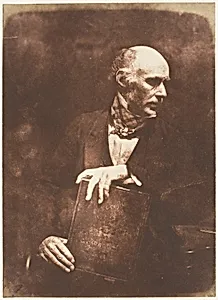
Rev. Mr. Smith of Borgue
Medium
Salted paper print from paper negative
Classification
Photographs
Department
Photographs
Museum
Metropolitan Museum of Art, New York, NY
Credit
Harris Brisbane Dick Fund, 1937
Accession Number
37.98.2.32
Rights
Public Domain
Tags
Art Historical Context
Step into the dawn of photography with *Rev. Mr. Smith of Borgue*, a captivating salted paper print from a paper negative created by the pioneering Scottish duo David Octavius Hill and Robert Adamson between 1843 and 1847. This intimate portrait, now housed in the Metropolitan Museum of Art's Photographs Department (thanks to the Harris Brisbane Dick Fund of 1937), exemplifies the calotype process—a groundbreaking technique using paper negatives that allowed for multiple prints and subtle tonal richness, unlike the sharper daguerreotypes of the era. Hill, a painter, and Adamson, a skilled chemist and photographer, formed one of photography's first artistic partnerships in Edinburgh amid the dramatic 1843 Disruption of the Church of Scotland. Hill enlisted Adamson to capture hundreds of portraits as studies for his monumental painting of the event, producing over 2,500 calotypes renowned for their painterly quality and psychological depth. Here, Rev. Mr. Smith of Borgue—a clergyman from rural Kirkcudbrightshire—gazes thoughtfully, books in hand, evoking scholarly wisdom and quiet dignity. These images bridged painting and photography, influencing portraiture's evolution and preserving mid-19th-century Scottish society with haunting immediacy. This modest yet masterful work highlights early photography's artistic potential, inviting us to ponder how light and chemistry forever changed how we see the human spirit.
About the Artist
David Octavius Hill|Robert Adamson|Hill and Adamson · 1802–1870
David Octavius Hill (1802–1870) was a Scottish painter, photographer, and arts administrator whose pioneering photography partnership with Robert Adamson from 1843 to 1847 transformed the medium into an art form. Born in Perth and trained in Edinburgh, Hill established himself as a landscape painter and became secretary of the Royal Scottish Academy, a position he held for nearly forty years. His ...