
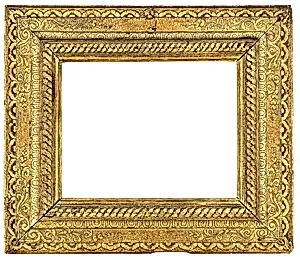
Reverse cassetta frame
Unknown Artist
ca. 1630
Medium
Oak. Carved, gilt; brown-red bole, dragon's blood.
Dimensions
Overall: 10 5/8 × 12 3/8 in. (27 × 31.5 cm) Sight: 5 11/16 × 7 3/8 in. (14.5 × 18.7 cm) Rabbet: 6 5/16 × 8 1/8 in. (16 × 20.6 cm)
Classification
Frames
Culture
Southern French
Department
Robert Lehman Collection
Museum
Metropolitan Museum of Art, New York, NY
Credit
Robert Lehman Collection, 1975
Accession Number
1975.1.2349
Rights
Public Domain
Art Historical Context
This exquisite **Reverse Cassetta Frame**, crafted around 1630 in Southern France, exemplifies the artistry of 17th-century frame-making, when ornate surrounds were as vital to paintings as the canvases they held. Housed in the Robert Lehman Collection at The Metropolitan Museum of Art, oak frame measures about 10½ by 12⅜ inches overall, with a sight size of roughly 5¾ by 7 inches—perfect for a small portrait or devotional panel. The "reverse cassetta" adapts the classic Italian Renaissance cassetta profile, flipping its deep, recessed moldings for a bolder, more sculptural effect that draws the eye inward, reflecting regional French innovations during the early Baroque era. Carved with intricate precision, the frame is gilded over a rich brown-red bole—a clay preparatory layer—and accented with dragon's blood, a vivid red resin pigment derived from tropical trees, adding warm depth to the gold. These techniques highlight the frame's dual role as both protector and enhancer, transforming a painting into a unified masterpiece. In Southern French workshops, such frames blended local woodworking traditions with luxury materials, signaling wealth and piety amid the Counter-Reformation's artistic fervor. Though by an unknown maker, this frame's survival underscores the undervalued craft of framers, whose work framed (pun intended) the era's visual culture. A true gem for frame enthusiasts! (198 words)