
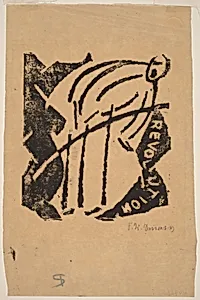
Revolution
1919-1920
Medium
woodcut in black on wove buff paper
Dimensions
sheet: 23.2 × 15 cm (9 1/8 × 5 7/8 in.)
Classification
Department
CG-W
Museum
National Gallery of Art, Washington, D.C.
Credit
Gift of Ruth Cole Kainen
Accession Number
2012.92.26
Rights
Public Domain
Art Historical Context
**Revolution** by Franz Wilhelm Seiw, created between 1919 and 1920, captures the turbulent spirit of post-World War I Europe through a striking woodcut in black ink on wove buff paper Measuring just 23.2 × 15 cm, this intimate print exemplifies Seiwert's early engagement with radical politics and modernist experimentation. As a German-born artist active in Cologne's avant-garde circles, Seiwert co-founded the Progressive Artists' Group, blending influences from Cubism Expressionism, and emerging Constructivism to address social upheaval. The woodcut medium—carved from wood blocks and hand-printed—lends the work its bold, graphic power, ideal for disseminating revolutionary ideas during Germany's Spartacist uprisings and the broader wave of leftist fervor. Rendered in stark black against warm buff paper, *Revolution* evokes urgency and solidarity, its angular forms likely symbolizing collective struggle amid economic collapse and political chaos. Housed in the National Gallery of Art as a gift from Ruth Cole Kainen (Department CG-W), this print highlights Seiwert's commitment to art as activism. Though small in scale, it resonates as a testament to early 20th-century printmaking's role in challenging the status quo, inviting visitors to reflect on art's enduring power to ignite change.