
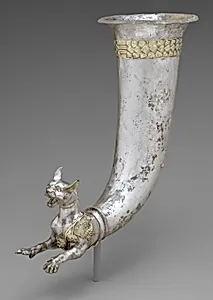
Rhyton terminating in the forepart of a wild cat
Unknown Artist
ca. 1st century BCE
Medium
Silver, mercury gilding
Dimensions
11 3/16 × 5 3/16 × 11 7/8 in. (28.4 × 13.1 × 30.2 cm)
Classification
Metalwork-Vessels
Culture & Period
Parthian · Parthian
Department
Ancient Near Eastern Art
Museum
Metropolitan Museum of Art, New York, NY
Credit
Purchase, Rogers Fund; Enid A. Haupt, Mrs. Donald M. Oenslager, Mrs. Muriel Palitz and Geert C. E. Prins Gifts; Pauline V. Fullerton Bequest; and Bequests of Mary Cushing Fosburgh, Edward C. Moore and Stephen Whitney Phoenix, by exchange, 1979
Accession Number
1979.447a, b
Rights
Public Domain
Tags
Art Historical Context
This elegant silver rhyton, crafted around the first century BCE in the Parthian Empire, takes the striking form of a wild cat’s forepart. Used as a ceremonial drinking vessel, it would have been tilted to pour wine from the animal’s open mouth. The Parthians, who ruled much of the ancient Near East, often blended Persian traditions with Hellenistic influences, and this vessel reflects that sophisticated cultural exchange. Created through mercury gilding—a technique that allowed artisans to apply a thin layer of gold to silver—the rhyton gleams with luxurious detail. Subtle grape motifs hint at its role in banquets and rituals celebrating fertility and abundance. Such zoomorphic vessels were prized symbols of status, connecting their owners to both the natural world and divine favor. Today housed in the Metropolitan Museum of Art’s Ancient Near Eastern collection, the piece offers a vivid glimpse into Parthian artistry and daily life. Its graceful lines and gleaming surface continue to captivate visitors, bridging millennia through the timeless appeal of fine craftsmanship.