
Right and Left Tribunes
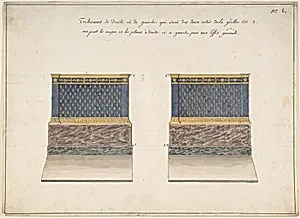
Medium
Pen and black ink with watercolor over graphite underdrawing; framing lines in pen and black ink
Dimensions
8 1/2 x 11 11/16 in. (21.6 x 29.7 cm)
Classification
Drawings|Ornament & Architecture
Department
Drawings and Prints
Museum
Metropolitan Museum of Art, New York, NY
Credit
The Elisha Whittelsey Collection, The Elisha Whittelsey Fund, 1949
Accession Number
49.50.173
Rights
Public Domain
Art Historical Context
Charles Percier (1764–1838), a leading French architect and designer of the Napoleonic era, created *Right and Left Tribunes a meticulous architectural drawing that exemplifies the opulent Empire style. Working alongside Pierre Fontaine, Percier shaped the grandeur of Napoleon's imperial interiors, blending neoclassical precision with lavish ornamentation. This sheet likely presents symmetrical designs for tribunes—elevated balconies or seating platforms—intended for grand halls or theaters, showcasing his expertise in decorative architecture. Executed in pen and black ink with watercolor a graphite underdrawing, the work reveals Percier's methodical process: faint pencil sketches refined into crisp lines, then heightened with subtle color for visual impact. The framing lines in ink suggest it was prepared for presentation or engraving, a common practice for disseminating designs to craftsmen. At just 8½ × 11⅝ inches, its intimate scale belies the monumental ambitions it represents. Housed in the Metropolitan Museum of Art's Drawings and Prints department as part of The Elisha Whittelsey Collection (acquired 1949), this piece offers a window into early 19th-century French design innovation. It highlights how such drawings bridged artistry and functionality, influencing Europe's decorative arts during a time of political transformation and aesthetic revival.
About the Artist
Charles Percier · 1764–1838
Charles Percier (1764–1838) rose from humble origins in Paris, where his mother laundered for Marie-Antoinette and his father served as a porter at the Tuileries Palace, to become one of France's most influential neoclassical architects and designers. From age twelve, he attended a free drawing school for indigent students, honing his skills in the studio of painter Louis-Jean-François Lagrenée be...