
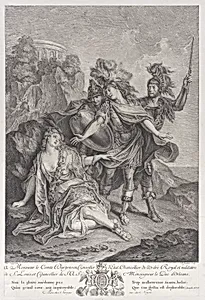
Rinaldo abandoning Armida
Medium
Engraving
Dimensions
Sheet (Trimmed): 15 5/8 × 10 7/16 in. (39.7 × 26.5 cm)
Classification
Prints
Department
Drawings and Prints
Museum
Metropolitan Museum of Art, New York, NY
Credit
Rogers Fund, 1962
Accession Number
62.602.1028
Rights
Public Domain
Art Historical Context
This engraving captures a dramatic moment from Torquato T’s epic poem *Jerusalem Delivered in which the Christian knight Rinaldo turns away from the enchanted sorceress Armida to rejoin his crusading companions. Created between 1720 and 1762 by Charles Antoine Coypel in collaboration with engravers François Joullain and Louis Surugue, the print translates Coypel’s painted composition into a finely detailed black-and-white image. The careful line work and tonal gradations typical of eighteenth-century French engraving allow the emotional tension of the farewell—Armida’s despair and Rinaldo’s resolve—to reach viewers beyond the original canvas. As a reproductive print, the work played an important role in spreading knowledge of contemporary history paintings throughout Europe. Coypel, a leading academic painter and later director of the Académie Royale, designed compositions that balanced theatrical gesture with refined elegance, reflecting the transition from late Baroque drama to the lighter spirit of the Rococo. Engravings such as this one made grand narratives accessible to collectors and students who might never visit the Salon, underscoring the period’s growing interest in literature, emotion, and moral choice. Measuring roughly 15 ⅝ by 10 7⁄16 inches, the trimmed sheet now resides in the Metropolitan Museum of Art’s Department of Drawings and Prints, acquired through the Rogers Fund in 1962. It stands as a vivid reminder of how artists, publishers, and engravers together shaped the visual culture of Enlightenment France.