
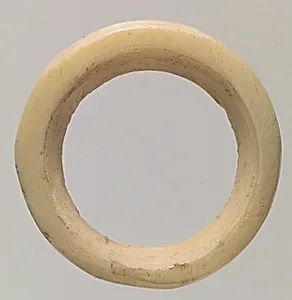
Ring
Unknown Artist
3rd–2nd millennium BCE
Medium
Shell
Dimensions
0.2 in. (0.51 cm)
Classification
Shell-Ornaments
Department
Ancient Near Eastern Art
Museum
Metropolitan Museum of Art, New York, NY
Credit
Rogers Fund, 1959
Accession Number
59.41.63
Rights
Public Domain
Art Historical Context
This delicate shell ring, crafted by an unknown artist during the 3rd–2nd BCE, offers a glimpse into the refined artistry of the Ancient Near East. Measuring just 0.2 inches (0.51 cm) in diameter, it exemplifies the exquisite miniaturization achieved by Mesopotamian or Sumerian jewelers, who transformed humble seashells into wearable treasures. Acquired through the Rogers Fund in 1959, it resides in the Metropolitan Museum of Art's Department of Ancient Near Eastern Art, classified among shell ornaments that adorned fingers, toes, or even hair. Shell, sourced likely from distant coastal regions via thriving trade networks, held both practical and symbolic value in this era. Its iridescent sheen and durability made it ideal for jewelry, reflecting advanced carving techniques—precise shaping and possible incising with stone tools—that demanded steady hands and expert skill. Such rings were not mere decoration; they signified personal status, gender roles, or ritual importance in early urban societies like Uruk or Ur. Today, this tiny artifact whispers of everyday elegance amid monumental ziggurats and cuneiform tablets, reminding us how ancient peoples celebrated beauty in the smallest scales. A testament to ingenuity, it bridges the Bronze Age past to our modern fascination with wearable art.