
Ring
Unknown Artist
12th century
Medium
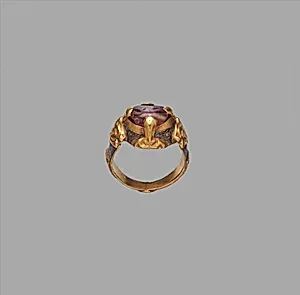
Gold; cast and fabricated from sheet, decorated with bitumen-highlighted incising, set with tourmaline bead
Dimensions
H. 15/16 in. (2.4 cm) W. 3/4 in. (1.9 cm) D. 1/2 in. (1.3 cm) Wt. 0.2 oz. (5.7 g)
Classification
Jewelry
Department
Islamic Art
Museum
Metropolitan Museum of Art, New York, NY
Credit
The Alice and Nasli Heeramaneck Collection, Gift of Alice Heeramaneck, 1980
Accession Number
1980.541.6
Rights
Public Domain
Art Historical Context
This exquisite 12th-century gold from the Islamic world exemplifies the masterful metalworking traditions of medieval artisans. Crafted through casting and fabrication from thin gold sheets, it measures just under an inch in height and width, making it a delicate piece suited for personal adornment. At its center sits a polished tourmaline bead—a semi-precious gemstone prized for its vibrant color and durability—encased in a bezel that highlights its luster. The ring's surface features intricate incising, where fine lines were engraved and filled with bitumen, a natural asphalt-like substance, to create dramatic contrast and depth. This technique, known as damascening or inlay work, was a hallmark of Islamic jewelry, allowing patterns to pop against the gleaming gold and ensuring longevity through the bitumen's protective qualities. Housed in the Metropolitan Museum of Art's Islamic Art Department as part of the Alice and Nasli Heeramaneck Collection, this anonymous work reflects the cultural prestige of jewelry in 12th-century Islamic societies. Such rings often symbolized status, love, or protection, blending artistry with everyday elegance in bustling trade hubs from Persia to Spain. A testament to enduring craftsmanship, it invites us to marvel at the skill of unseen hands.