
Ring bezel with scaraboid
Unknown Artist
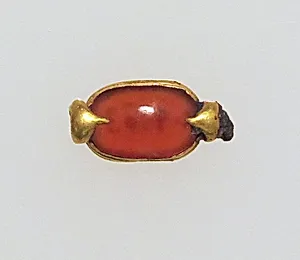
Medium
Gold, sard
Dimensions
Other: 1/4 × 1/8 × 9/16 in. (0.7 × 0.4 × 1.4 cm)
Classification
Gold and Silver
Department
Greek and Roman Art
Museum
Metropolitan Museum of Art, New York, NY
Credit
The Cesnola Collection, Purchased by subscription, 1874–76
Accession Number
74.51.4163
Rights
Public Domain
Art Historical Context
This delicate ring bezel with scaraboid, crafted from gleaming gold and sard (a reddish-brown chalcedony), exemplifies the exquisite jewelry of the ancient Mediterranean world. Measuring just a quarter-inch long, it once formed part of a finger ring, where the bezel—the setting that holds the scaraboid—would have showcased the carved stone seal. Housed in the Metropolitan Museum of Art's Greek and Roman Art department part of the Cesn Collection (acquired 1874–76), this tiny artifact highlights the technical mastery of ancient goldsmiths and gem engravers. Scaraboids, mimicking the sacred scarab beetle of Egyptian lore, were widespread amulets and seals across Cyprus, the Near East, and Greece from the Bronze Age onward. The beetle shape symbolized rebirth, protection, and the sun's cycle, often engraved with intaglios for stamping wax or clay. Gold's luster signified wealth and eternity, while sard provided a durable, vibrant canvas for intricate carvings, blending luxury with functionality. Though its precise date and maker remain unknown, this piece reflects Cyprus's role as a cultural crossroads, where Eastern motifs met emerging Greek influences. A personal talisman for its wearer, it invites us to ponder the daily magic of antiquity—slipped onto a finger for luck or authority in trade and ritual.