
Ring Inscribed for Queen Tiye
Unknown Artist
ca. 1390–1352 B.C.
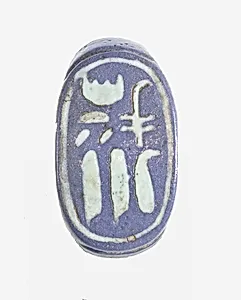
Medium
Faience
Dimensions
L. 2.4 cm (15/16 in)
Classification
Ring, Tiye, king's wife
Period
New Kingdom
Department
Egyptian Art
Museum
Metropolitan Museum of Art, New York, NY
Credit
Rogers Fund, 1911
Accession Number
11.215.83
Rights
Public Domain
Tags
Art Historical Context
This delicate faience ring, inscribed for Queen Tiye, hails from Egypt's New Kingdom, specifically Dynasty 18 (ca. 1390–1352 B.C.), a golden age of imperial power and artistic splendor under pharaohs like Amenhotep III, Tiye's husband. Measuring just 2.4 cm long, this tiny jewel was likely a finger ring or scaraboid, personalized with hieroglyphs honoring the queen—a formidable consort and mother whose influence extended across politics and religion. Crafted from faience, a glazed composite of quartz, lime, and clay fired to a vibrant turquoise hue, the ring mimics precious stones like lapis lazuli, making luxury accessible to elites. Faience's glassy sheen and durability made it ideal for jewelry, amulets, and ritual objects, symbolizing rebirth and eternity in Egyptian belief. The inscriptions, rendered in precise hieroglyphs, underscore Tiye's divine status, reflecting the era's devotion to royal iconography. Acquired through the Rogers Fund in 1911, this piece at the Metropolitan Museum of Art offers a intimate glimpse into royal life, evoking the grandeur of Thebes' palaces and the queen's enduring legacy amid the Amarna revolution. A testament to ancient ingenuity, it reminds us how even small artifacts carried profound cultural weight.