
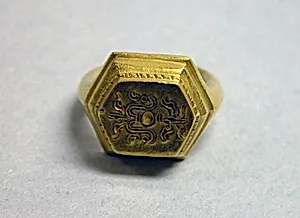
Ring with Hexagonal Bezel and "Sri" Inscription
Unknown Artist
Second half of the 9th–first quarter of the 10th century
Medium
Gold
Dimensions
H. 1/8 in. (0.3 cm); Diam. 7/8 in. (2.2 cm)
Classification
Jewelry
Culture & Period
Indonesia (Java) · late Central Javanese period
Department
Asian Art
Museum
Metropolitan Museum of Art, New York, NY
Credit
The Samuel Eilenberg-Jonathan P. Rosen Collection of Indonesian Gold, Bequest of Samuel Eilenberg and Gift of Jonathan P. Rosen, 1998
Accession Number
1998.544.383
Rights
Public Domain
Art Historical Context
This exquisite gold ring, hailing from Java, Indonesia, during the late Central Javanese period (second half of the 9th to first quarter of the10th century), showcases the refined artistry of an era marked by powerful Hindu-Buddhist kingdoms like the Sailendras and early Matarams. Crafted from pure gold—a precious metal symbolizing wealth, divinity, and eternal status—the ring features a distinctive hexagonal bezel, a geometric form that echoes the architectural precision seen in contemporary Javanese temples such as Prambanan. Its modest dimensions (height 0.3 cm; diameter 2.2 cm) belie its cultural weight, as such jewelry was likely worn by elites to convey prosperity and spiritual protection. The bezel's inscription of "Sri"—a Sanskrit honorific meaning "auspiciousness" or invoking the goddess of fortune, Lakshmi—highlights the deep Indian cultural influences permeating Java through trade and religion. Goldworking techniques, including hammering, chasing, and precise engraving, demonstrate masterful craftsmanship that ensured durability and luster. In a society where adornments bridged the mortal and divine, this ring served not just as personal ornament but as a talisman of good fortune. Now part of the Metropolitan Museum of Art's Asian Art collection, thanks to the Samuel Eilenberg-Jonathan P. Rosen bequest (1998), it offers a tangible link to Java's golden age of spiritual and artistic splendor.