
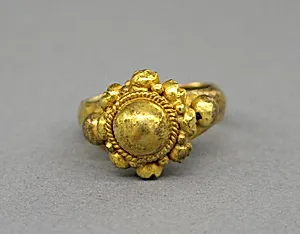
Ring with Large Central Boss Flanked by Series of Same
Unknown Artist
Last quarter of the 10th–last quarter of the 15th century
Medium
Gold
Dimensions
H. 1/8 in. (0.3 cm); Diam. 1 in. (2.7 cm)
Classification
Jewelry
Culture & Period
Indonesia (Java) · Eastern Javanese period
Department
Asian Art
Museum
Metropolitan Museum of Art, New York, NY
Credit
The Samuel Eilenberg-Jonathan P. Rosen Collection of Indonesian Gold, Bequest of Samuel Eilenberg and Gift of Jonathan P. Rosen, 1998
Accession Number
1998.544.442
Rights
Public Domain
Art Historical Context
This exquisite gold ring, hailing from Java, Indonesia, during the Eastern Javan period (last quarter of the 10 to last quarter of the 15 century), showcases the region's masterful metalworking traditions. Measuring just 1 inch in diameter and 1/8 inch high, its petite form belies its striking design: a large central boss—a raised, rounded ornament—flanked by a series of identical smaller bosses. Crafted entirely from gold, a precious metal symbolizing wealth and divine favor in ancient Southeast Asian societies, this piece was likely worn by elites as a status symbol or talisman. The Eastern Javanese period, marked by flourishing Hindu-Buddhist kingdoms like Kediri and Majapahit, produced some of the finest gold jewelry in Indonesian history. Artisans employed sophisticated techniques such as hammering, granulation, and repoussé to create intricate, repetitive motifs that evoked rhythm and harmony—qualities central to Javanese aesthetics influenced by cosmology and nature. Gold's durability ensured these heirlooms endured, offering glimpses into daily life and royal courts. Today, this ring from The Samuel Eilenberg-Jonathan P. Rosen Collection at The Metropolitan Museum of Art invites us to ponder the wearer's world: a time of grand temples, epic poetry, and spiritual devotion, where even the smallest adornment carried profound cultural weight.