
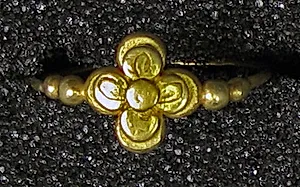
Ring with Ogee Centre
Unknown Artist
8th–12th century
Medium
Gold
Dimensions
Diam. 13/16 in. (2 cm)
Classification
Jewelry
Culture
Indonesia (Central Java)
Department
Asian Art
Museum
Metropolitan Museum of Art, New York, NY
Credit
Gift of the Eilenberg-Rosen Partnership, 2001
Accession Number
2001.794.126
Rights
Public Domain
Art Historical Context
This exquisite gold ring, titled *Ring with Ogee Centre hails from Central Java, Indonesia, and dates to the 8th–12th century—a golden era of Hindu-Buddhist kingdoms like the Sailendra and Mataram dynasties. Measuring just 13/16 inch (2 cm) in diameter, it exemplifies the refined jewelry crafted for Indonesia's elite during a time when monumental temples such as Borob and Prambanan were rising, blending Indian artistic influences with local Javanese ingenuity. The ring's standout feature is its ogee centre—an elegant, double-S-curved motif common in South and Southeast Asian ornamentation, evoking lotus petals or architectural arches. Fashioned entirely from gold, a precious metal symbolizing purity and divine favor, it highlights advanced metalworking techniques of the period, likely involving hammering, chasing, or soldering to achieve its delicate form. Such jewelry was more than adornment; it signified social status and spiritual protection. Today, this rare survivor graces the Metropolitan Museum of Art's Asian Art collection, gifted by the Eilenberg-Rosen Partnership in 2001. It offers a intimate glimpse into daily life amid Java's temple-building splendor, reminding us how personal treasures mirrored the grandeur of empires long past.