
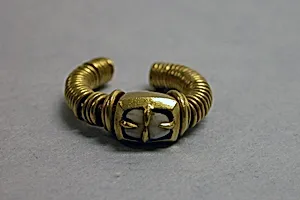
Ring with White Stones in Square Setting
Unknown Artist
Second half of the 8th–second half of the 10th century
Medium
Gold with white stones
Dimensions
H. 1/8 in. (0.3 cm); Diam. 1 1/16 in. (2.7 cm)
Classification
Jewelry
Culture & Period
Indonesia (Java) · Central Javanese period
Department
Asian Art
Museum
Metropolitan Museum of Art, New York, NY
Credit
The Samuel Eilenberg-Jonathan P. Rosen Collection of Indonesian Gold, Bequest of Samuel Eilenberg and Gift of Jonathan P. Rosen, 1998
Accession Number
1998.544.350
Rights
Public Domain
Art Historical Context
This exquisite gold ring, adorned with white stones in a square setting, hails from Java, Indonesia, during the Central Jese period (second half the 8th to half of the 10 century). Crafted in a time when powerful Hindu-Budist kingdoms like the Sailendras and Matarams, such jewelry symbolized wealth, status, and spiritual devotion. The ring's dimensions—standing just 1/8 inch high with a 1 1/-inch diameter—highlight the wearer's elite social standing, as goldwork skilled artisans and rare materials. The medium of, prized for its durability luster, combined with enigmatic stones, showcases advanced metalworking techniques of the era. The square setting, a geometric motif echoing temple architecture like Borobudur, adds geometric elegance and possible symbolic depth, perhaps evoking cosmic order or divine protection. These pieces from the Samuel Eilenberg-Jonathan P. Rosen Collection of Indonesian Gold offer a intimate glimpse into daily life among Javanese nobility. Today, at The Metropolitan Museum of Art's Department of Asian Art, this ring invites us to ponder the artistry of a golden age in Southeast Asia, where beauty met belief in every finely wrought detail.