
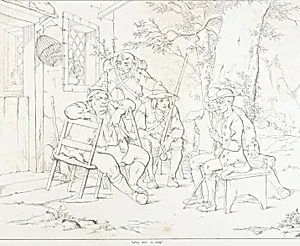
(Rip Van Winkle, illustration) Rip with Junto at the Village inn
Medium
Graphic Arts-Print
Classification
Graphic Arts-Print
Department
Smithsonian Collection
Museum
Smithsonian American Art Museum
Credit
Smithsonian American Art Museum, Transfer from the Library of the Smithsonian American Art Museum and the National Portrait Gallery, Smithsonian Institution
Accession Number
1976.149.3
Rights
Public Domain
Tags
Art Historical Context
In the cozy confines of a 19th-century village tavern, Octavius Carr Dar 1848 print *Rip with Junto at the Village* captures a pivotal scene from Washington Irving's beloved tale *Rip Van Winkle featured in *The Sketch Book of Geoffreyon, Gent.* (1819–1820). Here, the idle dreamer Rip lounges with his merry band of cronies, the Junto, amid pipes, ale, and lively conversation—evoking the lazy, pre-Revolutionary idyll that defines Irving's satire on colonial life. Darley, a master illustrator of American literature, brings Irving's words to vivid life through intricate line work typical of the era's graphic arts. As a wood engraving or similar print medium, this piece exemplifies the booming 19th-century American print culture, where affordable reproductions democratized art and storytelling. Darley's detailed style—sharp contrasts, expressive figures, and atmospheric tavern details—highlights his role in visualizing national myths, influencing later illustrators like those for Harper's Weekly. Culturally, it immortalizes *Rip Van Winkle* as a cornerstone of American folklore, symbolizing transformation from old-world complacency to post-independence vigor. On view at the Smithsonian American Art Museum (transferred from its library collections), this print invites visitors to ponder how simple tavern chats birthed enduring legends.