
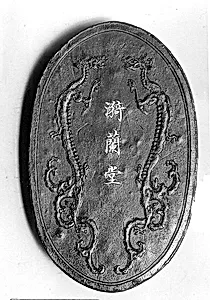
Rippling Water Hall
late 19th–early 20th century
Medium
Ink
Dimensions
H. 3 3/8 in. (8.6 cm); W. 2 1/8 in. (5.4 cm)
Classification
Ink
Culture & Period
China · late Qing dynasty (1644–1911) or early Republic period (1912–49)
Department
Asian Art
Museum
Metropolitan Museum of Art, New York, NY
Credit
Rogers Fund, 1930
Accession Number
30.76.268
Rights
Public Domain
Tags
Art Historical Context
Nestled in the Metropolitan Museum of Art's Asian Art collection, *Rippling Water Hall* Jian Guzhai is a ink artwork from late 19th–early 20th-century, spanning the late Qing dynasty (1644–1911) or early Republic period (191–49). Measuring just 3⅜ × 2⅛ inches (8.6 × 5.4 cm), thisutive piece exemplifies the refined artistry of scholar's studio objects, where even everyday tools became poetic expressions. Acquired through the Rogers Fund in 1930, it captures a transitional era when imperial traditions mingled with modern stirrings. Crafted in ink, likely as a molded ink cake or slab—one of the "Four Treasures of the Study" essential for calligraphy and painting—its title evokes serene, flowing water, enhanced by dragon motifs symbolizing power, auspiciousness, and imperial might in Chinese culture. These creatures, often rendered in intricate relief, reflect literati tastes for nature-inspired elegance and subtle symbolism. Jian Guzhai's work highlights masterful ink manipulation, achieving depth and texture on a tiny scale. This piece invites visitors to ponder the scholar's world: a ritual of grinding ink on stone, unleashing creativity amid political flux. Its cultural resonance endures, bridging art and daily ritual in Qing-Republic refinement.
About the Artist
Jian Guzhai
Jian Guzhai — meaning roughly "Studio for Appreciating the Antique" — was a renowned ink-tablet workshop operated by the Wang Jinsheng family in the Huizhou region of Anhui Province, China, one of the historic centers of fine inkstick production. Active during the late Qing dynasty (1644–1911) and possibly into the early Republic period (1912–49), the workshop was celebrated for producing ink tabl...