
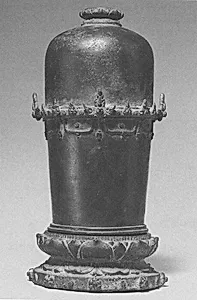
Ritual Object (Linga?)
Unknown Artist
ca. 11th century
Medium
Bronze
Dimensions
H. 8 in. (20.3 cm); Diam. 4 1/8 in. (10.5 cm)
Classification
Sculpture
Culture & Period
Indonesia (Java) · Eastern Javanese period
Department
Asian Art
Museum
Metropolitan Museum of Art, New York, NY
Credit
Sameul Eilenberg Collection Gift of Samuel Eilenberg, 1987
Accession Number
1987.142.178
Rights
Public Domain
Art Historical Context
This exquisite bronze ritual object, tentatively as a *linga*, hails from Java, Indonesia, during the Eastern Javanese around the 11th century Standing just 8 inches tall with a diameter of over 4 inches, its compact form belies its profound spiritual weight. Crafted by an unknown artist, it exemplifies the sophisticated metalworking traditions of ancient Javanese kingdoms, where flourished alongside Buddhism in opulent temple complexes like those at Prambanan. In Hindu Shaivite tradition, the *linga* symbolizes the divine energy of Shiva, serving as a focal point for worship, fertility rites, and meditation. Javanese examples like this one often feature a smooth, cylindrical shaft rising from a disc-like base (*yoni*), representing the union of male and female principles. The object's lustrous bronze surface, likely achieved through lost-wax casting—a masterful technique allowing intricate details—highlights the era's artistic prowess and devotion to sacred iconography. Acquired through the Samuel Eilenberg Collection and gifted to the Metropolitan Museum of Art in 1987, this piece offers a tangible link to Java's golden age of religious art, inviting visitors to ponder the enduring mystery of ancient rituals.