
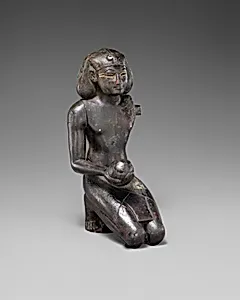
Ritual Statuette of Thutmose III
Unknown Artist
ca. 1479–1425 B.C.
Medium
Black bronze, gold inlay
Dimensions
h. 13.1 cm (5 1/8 in) [16.2 cm (6 3/8 in) with tang]; w. 6.0 cm (2 3/8 in); d. 7.6 cm (3 in)
Classification
Statuette, kneeling king, Thutmose III
Period
New Kingdom
Department
Egyptian Art
Museum
Metropolitan Museum of Art, New York, NY
Credit
Purchase, Edith Perry Chapman Fund and Malcolm Hewitt Wiener Foundation Inc. Gift, 1995
Accession Number
1995.21
Rights
Public Domain
Tags
Art Historical Context
This exquisite ritual statuette depicts Thutmose III, of ancient Egypt's greatest warrior-pharaohs, who ruled during the New Kingdom's 18th Dynasty (. 1479–1425 B.C.). Standing just over 5 inches tall, the figure captures the king in a classic striding pose, embodying eternal vigilance and divine kingship. Thutmose III transformed Egypt into a vast empire through military campaigns, and such statuettes served vital religious purposes: placed in temples, they housed the ruler's ka—his vital spirit—allowing priests to offer daily rituals that sustained his power in the afterlife. Crafted from black bronze with gleaming gold inlay, likely accentuating the eyes for a lifelike gaze, the sculpture showcases advanced lost-wax casting techniques perfected by Egyptian artisans. The dark bronze, possibly from a copper-arsenic alloy, contrasts dramatically with the precious gold, symbolizing the pharaoh's fusion of earthly might and celestial divinity. Its compact size and tang base suggest it was mounted on a larger shrine or altar, emphasizing portability for processions. Housed in the Metropolitan Museum of Art's Egyptian Art Department, this rare piece highlights the New Kingdom's artistic pinnacle, where portraiture blended idealism with subtle individuality. Visitors can marvel at how such works bridged the mortal and divine, ensuring Thutmose III's legacy endured for millennia.