
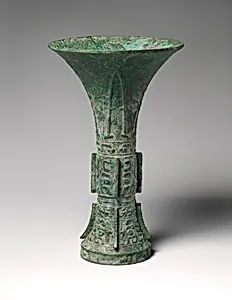
西周 青銅觚|Ritual Wine Beaker (Gu)
Unknown Artist
late 11th century BCE
Medium
Bronze
Dimensions
H. 8 1/4 in. (21 cm); Diam. of rim: 5 in. (12.7 cm); Diam. of foot: 2 13/16 in. (7.1 cm); Wt. 1 lb. (0.5 kg)
Classification
Metalwork
Culture & Period
China · Western Zhou dynasty (1046–771 B.C.)
Department
Asian Art
Museum
Metropolitan Museum of Art, New York, NY
Credit
Munsey Fund, 1931
Accession Number
24.72.10
Rights
Public Domain
Art Historical Context
Step into the world of ancient China with this elegant bronze ritual wine beaker, or *gu*, crafted during the late 11th century BCE the Western Zhou dynasty (6–771 BCE). at 8¼ inches tall with a flared rim and slender foot, this vessel exemplifies the refined metalwork of its era, now housed in the Metropolitan Museum Art's Asian Art departmentIn the Western Zhou period, bronze vessels like this *gu* were essential for ritual ceremonies, particularly offerings of wine to ancestors and deities. They symbolized power, piety, and social status among the elite, often buried in tombs to accompany the deceased into the afterlife. The Zhou dynasty built on Shang traditions, emphasizing hierarchical rituals that reinforced royal authority and cosmic harmony. Bronze casting via the sophisticated piece-mold technique allowed for intricate designs and precise forms, showcasing the era's metallurgical mastery. This *gu*'s graceful proportions highlight the shift toward more elegant, less monstrous motifs compared to earlier Shang wares, reflecting evolving aesthetic and cultural values. A true treasure from over 3,000 years ago!