
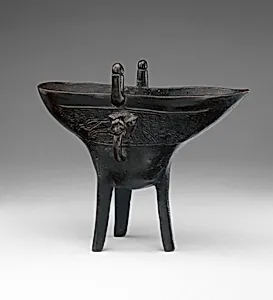
Ritual wine cup (jue)
Unknown Artist
dated 1520
Medium
Bronze
Dimensions
H. 5 3/8 in. (13.7 cm); W. 2 3/8 in. (6 cm); D. 6 1/4 in. (15.9 cm)
Classification
Metalwork
Culture & Period
China · Ming dynasty (1368–1644)
Department
Asian Art
Museum
Metropolitan Museum of Art, New York, NY
Credit
Rogers Fund, 1912
Accession Number
12.7.1
Rights
Public Domain
Art Historical Context
This exquisite bronze ritual wine cup, as a *jue*, dates to 1520 during China's Ming dynasty (1368–1644). Standing just 5⅜ inches tall, with a width of 2⅜ inches and depth of 6¼ inches, its compact form belies its profound cultural weight. Crafted in the Asian Art tradition of metalwork, it exemplifies the Ming era's masterful bronze casting techniques, likely employing intricate piece-mold methods to achieve smooth surfaces and precise detailing. Originally popularized in the Bronze Age Shang dynasty (c. 1600–1046 BCE), the *jue* was essential for libation rituals in ancestor worship, symbolizing harmony between the living and the divine. By the Ming period, scholar-officials revived these archaic forms amid a renaissance of antiquarianism, collecting and replicating ancient vessels to evoke Confucian ideals of piety and historical continuity. This example reflects that scholarly passion, blending technical virtuosity with spiritual reverence. Acquired through the Rogers Fund in 1912, it now graces the Metropolitan Museum of Art, inviting visitors to ponder the enduring legacy of Chinese ritual art—where metal not only holds wine but preserves millennia of tradition.