
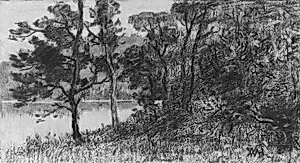
River Landscape
ca. 1877
Medium
Charcoal on off-white laid paper
Dimensions
9 1/2 x 16 13/16 in. (24.1 x 42.7 cm)
Classification
Drawing
Culture
American
Department
The American Wing
Museum
Metropolitan Museum of Art, New York, NY
Credit
Purchase, Gifts in memory of Stephen D. Rubin, 1992
Accession Number
1992.66.1
Rights
Public Domain
Tags
Art Historical Context
William Morris Hunt's *River Landscape* (ca. 1877) captures the tranquil beauty of a natural riverside scene, with flowing water, lush trees, and expansive vistas rendered in soft, evocative strokes. As a leading American artist of the 19th century, Hunt inspiration from his European training, particularly the Barbizon school's emphasis on plein-air sketching and direct observation of nature. This intimate drawing, measuring just 9½ x 16⅞ inches, reflects his skill in translating fleeting outdoor impressions onto paper during the Gilded Age, a time when American artists increasingly celebrated their native landscapes amid rapid industrialization. Executed in charcoal on off-white laid paper—a textured 19th-century support ideal for capturing light and shadow—Hunt employs bold, fluid lines and subtle smudging to evoke depth and atmosphere. Charcoal's versatility allowed for rapid, expressive studies like this, highlighting tonal contrasts between the shimmering river and dense foliage. Such works were foundational to Hunt's practice, bridging studio painting and on-site improvisation. Housed in The Metropolitan Museum of Art's American Wing, this piece underscores Hunt's pivotal role in advancing landscape traditions in American art. Acquired through a 1992 purchase honoring Stephen D. Rubin, it invites visitors to appreciate the quiet poetry of everyday scenery through a master's hand.
About the Artist
William Morris Hunt · 1824–1879
American, Brattleboro, Vermont 1824–1879 Appledore, New Hampshire