
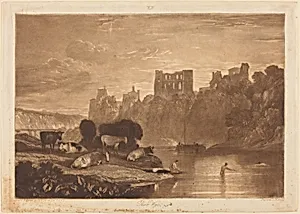
River Wye
published 1812
Medium
etching
Classification
Department
CG-E
Museum
National Gallery of Art, Washington, D.C.
Credit
Rosenwald Collection
Accession Number
1943.3.8176
Rights
Public Domain
Art Historical Context
"River Wye," an exquisite etching published in 181, showcases the masterful collaboration between Joseph Mallord William Turner, the preeminent British Romantic artist, and engraver W.T. Annis. Housed in the National Gallery Art's Rosenwald CollectionDepartment CG-E), this captures the serene beauty of the River W, a meandering waterway along the England-Wales border famed for its dramatic landscapes. Turner's etching technique—drawing directly into a metal plate with acid to create fluid, expressive lines—allowed him to evoke the river's misty atmosphere and rugged charm with remarkable spontaneity. Turner, renowned for his luminous watercolors and oils that heralded the Impressionists, turned to printmaking to democratize his visions of Britain's sublime scenery. This work likely stems from his extensive sketching tours, reflecting the early 19th-century Romantic fascination with nature's grandeur amid the Industrial Revolution's encroachment. Etchings like this were affordable alternatives to paintings, making high art accessible to a wider audience. A highlight of Turner's innovative print series, "River Wye" invites viewers to ponder the timeless allure of unspoiled wilderness, blending technical precision with poetic evocation. Its presence in the NGA underscores the enduring legacy of Turner's ability to transform etched lines into shimmering light and shadow.