
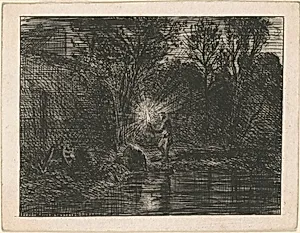
Riverbank at Night
Medium
etching on wove paper
Dimensions
image: 6 × 7.8 cm (2 3/8 × 3 1/16 in.) sheet: 6.8 × 8.9 cm (2 11/16 × 3 1/2 in.)
Classification
Department
CG-E
Museum
National Gallery of Art, Washington, D.C.
Credit
Purchased as the Gift of Andrew Robison
Accession Number
2016.106.1
Rights
Public Domain
Art Historical Context
**Riverbank at Night**, a delicate etching created by French artist Charles Émile Jacque in 1844, captures a serene nocturnal landscape along a riverbank. Measuring just 6 × 7.8 cm, this intimate print on wove paper invites close contemplation, its small scale evoking the quiet poetry of twilight. Jacque, a key figure in the Barbizon School, was renowned for his realistic depictions of rural life, animals, and nature, blending Romantic lyricism with emerging Realism during a time when artists were shifting from idealized scenes to everyday observations. Etching, Jacque's chosen medium here, allowed for fine lines and subtle tonal effects, achieved by biting acid into a metal plate to create intricate textures—like the shimmering water or shadowed foliage. Wove paper, smooth and uniform, enhanced the precision of these details, making it ideal for 19th-century printmaking. Night scenes were rare in this era, highlighting Jacque's innovative approach to light and mood, which foreshadowed later Impressionist experiments with atmosphere. Acquired by the National Gallery of Art as the Gift of Andrew Robison and housed in the CG-E department, this print exemplifies the technical mastery of French graphic arts in the 1840s. Visitors will appreciate its evocative stillness, a window into Jacque's world where nature unfolds under the stars.