
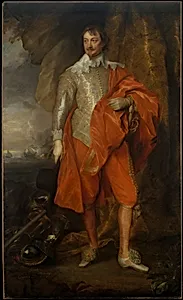
Robert Rich (1587–1658), Second Earl of Warwick
ca. 1632–35
Medium
Oil on canvas
Dimensions
81 7/8 x 50 3/8 in. (208 x 128 cm), with added strip of 2 1/8 in. (5.4 cm) at top
Classification
Paintings
Department
European Paintings
Museum
Metropolitan Museum of Art, New York, NY
Credit
The Jules Bache Collection, 1949
Accession Number
49.7.26
Rights
Public Domain
Tags
Art Historical Context
Anthony van Dyck's portrait of **Robert Rich (1587–1658), Earl of Warwick**, painted around 1632–, exemplifies the Flemish master's elegance during his influential English period. As principal court painter to King Charles I from 1632, van Dyck elevated portraiture with his Baroque style—characterized by fluid brushwork, rich glazes, and a sense of grandeur. This large oil on canvas (originally 208 x 128 cm, with a 5.4 cm strip added the top, likely for reframing) captures the earl in a poised, aristocratic pose, his lavish attire and commanding presence reflecting the opulence of Stuart England. Robert Rich was a powerful nobleman and Parliamentarian figure, known for his roles in colonial enterprises like the Virginia Company and as Lord Admiral. Painted amid rising political tensions before the English Civil War, the work underscores van Dyck's skill in conveying status and character, blending psychological insight with idealized beauty inherited from his teacher Rubens. Housed in the Metropolitan Museum of Art's European Paintings department (The Jules Bache Collection, 1949), this portrait highlights the cultural prestige of 17th-century English elites, inviting viewers to ponder the era's blend of splendor and impending upheaval.
About the Artist
Anthony van Dyck · 1599–1641
Sir Anthony van Dyck (1599-1641) was a Flemish Baroque artist who revolutionized portrait painting and became the most influential court painter in 17th-century England. Born in Antwerp as the seventh of twelve children to a prosperous silk merchant, van Dyck displayed extraordinary artistic talent from childhood. He trained under Hendrick van Balen before joining Peter Paul Rubens's workshop as a...