
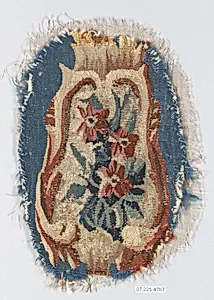
Rocaille cartouche with flowers
ca. 1735–50
Medium
Wool, silk (20-22 warps per inch, 8 per cm.)
Dimensions
11 × 6 in. (27.9 × 15.2 cm)
Classification
Textiles-Tapestries
Culture
French, probably Beauvais
Department
European Sculpture and Decorative Arts
Museum
Metropolitan Museum of Art, New York, NY
Credit
Gift of J. Pierpont Morgan, 1906
Accession Number
07.225.47b3
Rights
Public Domain
Tags
Art Historical Context
This exquisite *Rocaille cartouche with flowers*, woven by the renowned Beauvais tapestry manufactory in France around 1735–50, exemplifies the playful elegance of the Rococo style. Beauvais, established in 1664, was celebrated for producing lighter, more colorful tapestries than its Lyon counterpart, often featuring floral motifs suited for fashionable interiors. The rocaille design—characterized by scrolling, shell-like forms—frames a vibrant bouquet of flowers, capturing the era's delight in nature's asymmetry and exuberance during Louis XV's reign. Crafted from wool and silk with a fine weave of 20-22 warps per inch (8 per cm), this small panel (11 × 6 in.) showcases masterful textile techniques. The silk adds luster to the petals and leaves, while wool provides durability, making it ideal for upholstery or decorative screens in opulent salons. Such cartouches served as ornamental vignettes, enhancing furniture or walls in aristocratic homes. A gift to the Metropolitan Museum of Art from J. Pierpont Morgan in 1906, this piece highlights the cultural prestige of French decorative arts, blending artistry with luxury to evoke the refined whimsy of 18th-century France.