
Rock Crystal Belt Buckle
Unknown Artist
ca. 500 (buckle), 500–600 (tongue)
Medium
Rock crystal, gold foil
Dimensions
Overall: 1 3/4 x 1 9/16 x 11/16 in. (4.5 x 4 x 1.8 cm)
Classification
Lapidary Work-Crystal
Culture
East German (buckle), Byzantine (tongue)
Department
Medieval Art
Museum
Metropolitan Museum of Art, New York, NY
Credit
Purchase, Rogers Fund; Alastair B. Martin, William Kelly Simpson, Scher Chemicals Inc. and Max Falk Gifts; and funds from various donors, 1995
Accession Number
1995.54
Rights
Public Domain
Art Historical Context
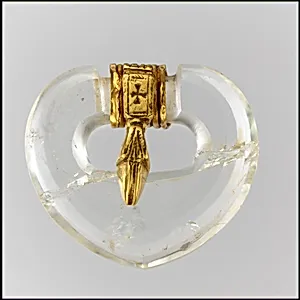
This exquisite Rock Crystal Belt Buckle, to around 500 AD for the East German buckle and 500–600 AD for its tongue, exemplifies the masterful lapidary work of early medieval artisans. Crafted from translucent rock crystal—a prized, exceptionally hard material—enhanced with shimmering gold foil, the piece measures a compact 1 3/4 x 1 9/16 x 11/16 inches. Acquired by the Metropolitan Museum of Art 1995, it two distinct cultures: the Ostrogothic East Germanic world of Italy under King Theodoric and the sophisticated Byzantine Empire. The buckle's composite nature highlights the vibrant cultural exchanges of late antiquity, as Germanic tribes interacted with the Eastern Roman Empire through trade, conquest, and diplomacy. Belts like this were status symbols for elite warriors and nobility, their gleaming crystal evoking luxury and prestige amid the turbulent Migration Period. Artistically, the work showcases advanced techniques in carving durable quartz crystal, likely hollowed and backed with gold foil to amplify light play and iridescence. Such jewelry not only secured garments but served as portable wealth, reflecting the fusion of Germanic vigor and Byzantine opulence that shaped early medieval Europe.