
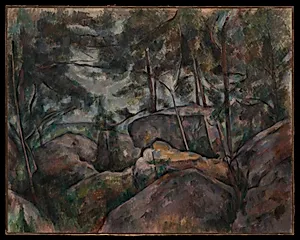
Rocks at Fontainebleau
1890s
Medium
Oil on canvas
Dimensions
28 7/8 x 36 3/8 in. (73.3 x 92.4 cm)
Classification
Paintings
Department
European Paintings
Museum
Metropolitan Museum of Art, New York, NY
Credit
H. O. Havemeyer Collection, Bequest of Mrs. H. O. Havemeyer, 1929
Accession Number
29.100.194
Rights
Public Domain
Tags
Art Historical Context
Paul Cézanne's *Rocks at Fontaineble*, painted in the 1890s, captures rugged beauty of the Fontainebleau forest south of Paris—a beloved haunt for artists seeking inspiration from nature's raw forms. This oil on canvas landscape (28 7/8 x 36 3/8 in.) showcases massive boulders amid dense woods, a motif Cézanne revisited throughout his career. As a pioneer of Post-Impressionism, moved beyond Impressionist fleeting light to emphasize the solid geometry of the natural world, treating rocks and trees as interlocking volumes that build a structured composition. Cézanne's revolutionary technique shines here: deliberate, blocky brushstrokes in modulated colors create depth and form, prefiguring Cubism. He famously urged artists to "treat nature by means of the cylinder, the sphere, the cone," and this work exemplifies that analytical approach, inviting viewers to see the landscape's underlying architecture. Its presence in the Metropolitan Museum of Art's European Paintings department, from the H. O. Havemeyer Collection (bequeathed in 1929), underscores its status as a cornerstone of modern art collecting. Step into this serene forest scene and feel Cézanne's enduring quest to reconcile observation with abstraction— a timeless invitation to rediscover nature's quiet power.
About the Artist
Paul Cézanne · 1839–1906
Paul Cézanne (1839-1906) stands as one of the most influential figures in the history of modern art, often called the "Father of Modern Art" for his revolutionary approach to form, color, and pictorial space. Born in Aix-en-Provence to a wealthy banker who discouraged artistic pursuits, Cézanne rejected a legal career to pursue painting, though he remained financially dependent on his family until...