
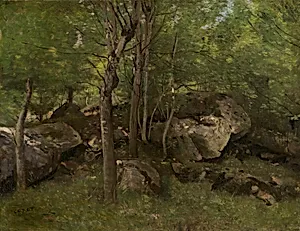
Rocks in the Forest of Fontainebleau
1860/1865
Medium
oil on canvas
Dimensions
overall: 46 x 59 cm (18 1/8 x 23 1/4 in.) framed: 65.4 x 78.7 cm (25 3/4 x 31 in.)
Classification
Painting
Department
CF
Museum
National Gallery of Art, Washington, D.C.
Credit
Chester Dale Collection
Accession Number
1963.10.110
Rights
Public Domain
Art Historical Context
Jean-Baptiste-Camille Corot’s *Rocks in the Forest of Fontainebleau* captures a quiet corner of the famed French woodland that drew generations of artists in the nineteenth century. Painted in oil on canvas between 1860 and 1865, the work measures just 46 by 59 centimeters, inviting close viewing of its rocky outcrops and filtered light. Corot, a leading figure of the Barbizon circle, used the medium’s rich tonal range to suggest both the solidity of stone and the softness of foliage, creating an atmosphere that feels both observed and gently poetic. Fontainebleau’s ancient trees and dramatic boulders had become a symbol of unspoiled nature for painters seeking alternatives to academic studio practice. Corot’s late landscapes, including this one, helped bridge the detailed naturalism of the Barbizon school with the freer brushwork of Impressionism. The modest size and intimate framing encourage viewers to experience the forest as a place of personal reflection rather than grand spectacle. Today in the National Gallery of Art’s collection as part of the Chester Dale gift, the painting continues to illustrate Corot’s lifelong interest in finding harmony between human presence and the natural world. Its restrained palette and careful balance of light and shadow reward patient looking, revealing the artist’s gift for turning a simple woodland scene into a meditation on time and place.
About the Artist
Jean-Baptiste-Camille Corot · 1796–1875
Jean-Baptiste-Camille Corot, born on July 16, 1796, in Paris to a prosperous bourgeois family—his father a former wig-maker turned draper and his mother a successful milliner—was initially apprenticed in the textile trade but pursued art from his mid-twenties with family support. He studied under the neoclassical landscapist Achille Etna Michallon in 1821–1822, who taught him to sketch outdoors in...