
Rolling Pin
c. 1940
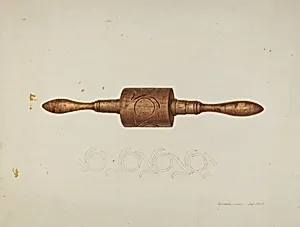
Medium
watercolor and graphite on paperboard
Dimensions
overall: 26.7 x 35.7 cm (10 1/2 x 14 1/16 in.)
Classification
Index of American Design
Department
CG-W
Museum
National Gallery of Art, Washington, D.C.
Credit
Index of American Design
Accession Number
1943.8.13370
Rights
Public Domain
Art Historical Context
Edward L. Loper’s *Rolling Pin* (c. 1940) belongs to the Index of American Design, a remarkable New Deal initiative that employed hundreds of artists to create a visual archive of everyday American objects. Rendered in delicate watercolor and graphite on paperboard, the work captures a simple kitchen tool with quiet precision, transforming an ordinary household item into a record of American craft and domestic life. Measuring just over 10 by 14 inches, the drawing exemplifies the project’s goal of documenting vernacular design before such objects disappeared from daily use. The Index, active from 1935 to 1942 under the Works Progress Administration, produced thousands of similar studies that now form an invaluable resource at the National Gallery of Art. Loper’s careful technique—combining the transparency of watercolor with the fine detail of graphite—allowed for both accuracy and subtle tonal warmth, qualities essential to the project’s documentary mission. By focusing on a humble rolling pin, the work quietly celebrates the beauty found in functional American design and the hands that shaped it.
About the Artist
Edward L. Loper · 1916–2011
Edward Leroy Loper Sr. was born on April 7, 1916, in Wilmington, Delaware, to a poor family in the racially mixed Frogtown neighborhood, where he was raised primarily by his maternal grandmother. After graduating from Howard High School, the only secondary school available to African Americans in Delaware at the time, Loper received no formal artistic training initially but immersed himself in sel...