
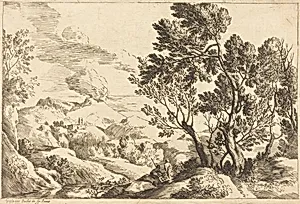
Roman Landscape
1601 to 1650
Medium
etching
Classification
Department
CG-E
Museum
National Gallery of Art, Washington, D.C.
Credit
Ailsa Mellon Bruce Fund
Accession Number
1974.54.2
Rights
Public Domain
Art Historical Context
Gaspard Dughet'sRoman Landscape*, an etching from the mid-17th century (. 1601–1650), captures the timeless beauty of the Roman countryside, a hallmark of the artist's oeuvre. Dughet, a French painter active in Rome and brother-in-law to Nicolas Poussin, mastered the classical landscape tradition, blending idealized nature with subtle classical ruins. This print, acquired through the Ailsa Mellon Fund for the National Gallery of Art Department of Prints (CG-E), exemplifies his to evoke the grandeur of ancient Rome amid lush, atmospheric scenery. Etching, Dughet's chosen medium here, was a revolutionary printmaking technique in the Baroque era, allowing artists to create intricate lines with acid-etched copper plates for precise tonal effects and textures. Dughet's etchings, relatively rare compared to his oil paintings, democratized his vision, spreading the Roman landscape style across Europe and influencing later generations of landscapists like Claude Lorrain. This work holds cultural significance as a window into 17th-century Rome's allure for foreign artists, celebrating nature's harmony with antiquity. Visitors will appreciate its delicate lines and evocative mood, a testament to Dughet's enduring legacy in bridging painting and printmaking.
About the Artist
Gaspard Dughet · 1615–1675
He was famed as a distinguished landscape painter working in Rome in the 17th century, painting decorative frescoes and easel paintings for major Roman patrons, including Pope Innocent X and the Colonna family. He is linked to a new genre of landscape, the storm scene, however his most characteristic works depict the beauty of the scenery around Rome, particularly near Tivoli. He was particularly ...